Micah Kellner, Assemblyman of the 65th district of Manhattan's Upper East Side, released his ethics disclosure form for us to post and for all to see. It's available as a PDF file download here. For the unfamiliar it's worth reading for the range of questions.
We invite other members of the legislature to send their non-redacted disclosure forms; we'll post them too. Send to brennancenter@nyu.edu, subject line "Full Disclosure."
The Assembly Ethics Committee will reportedly meet today. Since the proceedings are cloaked in secrecy the could be talking about a number of things. As the WXXI story points out, unlike other legislative standing committees, the Ethics Committee is not required to deliberate in public and neither their deliberations or finding are made public.
This isn't the Manhattan Project; these are our elected representatives and the public has a right to know about the work of the committee.
In fact, the legislative ethics committees, not to be confused with the similarly secretive Legislative Ethics Commission, rarely holds meetings. This stands in stark contrast to the recently created Commission on Public Integrity, which oversees the executive branch and lobbyists. The CPI holds regular public hearings and releases its opinions.
Since all four members of the legislature who either stand accused of corruption, plead guilty, await sentencing or face a trial all hail from New York City, here's an idea for a new Manhattan Project: hold public hearings on the various models for ethics reform.
In April of this year my former colleague Beth Foster and I had the pleasure of participating Common Cause's Reform Day of Action. Included in our list of meetings was Assemblyman Anthony Seminerio, who now stands accused of banking $500,000 for his official duties.
We spoke about the many items on the reform agenda: campaign finance, redistricting, rules and, of course, ethics.
The Assemblyman's response to our position that Albany needed reforming? "Why? What's wrong with Albany," he said rhetorically.
One of the quirks of ethics reform ushered through in 2007 is that the new Commission on Public Integrity (CPI), which combined the Temporary Commission on Lobbying and the Ethics Commission, has jurisdiction over the executive branch, but not the Legislature. However, CPI also has jurisdiction over lobbyists who do business with both branches of government.
The recent charges against Assemblyman Anthony Seminerio present an interesting situation, The compliant alleges that nearly $400,000 was paid to a consulting company controlled by Seminerio by a Queens hospital since 2000. According to a NewYork Times story earlier this week: "several hospital industry officials said that the hospital described in the complaint fit the profile of Jamaica Hospital Medical Center in Queens."
I've argued before that CPI should take an activist stance with its jurisdiction and issue opinions that may only affect the executive branch, but nonetheless would serve as a warning to the Legislature. That was in the case of a city public school, er, campus naming for Queens Senator Frank Padavan, who was and is in the midst of a reelection fight tied to control of his chamber. (The city Chancellor's regulations forbid naming public school after the living, but is silent as to a campus.)
In Padavan's example, the CPI could have issued an opinion that naming public property for people serving in the executive branch is a violation of the public officers law since there is an obvious value attached. (Elected officials cannot receive extra compensation or any gift of more than nominal value.) For proof look no further than the multi-million dollar annual price tags for naming rights for the area stadiums under construction. I wasn't arguing then or now that public schools are on the order of sports stadiums, merely that naming rights have some value.
True a CPI opinion about naming public would have no force on the Legislature, however it would have served as notice by a respected body and a warning that somebody is minding the ethics store.
Yesterday news broke that longtime Queens Assemblyman Anthony Seminerio has been a accused of taking more than $500,000 from businesses. According to today's New York Times story: "His state ethics forms for 2005, 2006 and 2007 list him as receiving at least $1,000 each year from Marc Consultants." Actually it was quite a bit more, and--here's the important part-- for “the performance of his official duties as a member of the Assembly.”
Part of the problem is that the state's Legislative Ethics Commission, which was created as part of the Public Employees Ethics Reform Act of 2007 (PEERA), is completely opaque. Late last year Casey Hynes and Sarah Clyne Sundberg wrote for a well-researched story about the commission for the Albany Times Union:
But in the 20 years since, despite many instances of elected officials mingling private business interests with political dealings, not a single lawmaker has been sanctioned or pursued criminally through the rules.
Critics say new rules enacted this year by Gov. Eliot Spitzer and other state leaders, who have characterized their work as the most sweeping ethics and lobbying changes in state history, may again fall short.
Lawmakers still control who gets appointed to oversight commissions, enabling the leaders to effectively police themselves through politicized committees whose jobs are to ferret out wrongdoing and report suspected crimes to prosecutors.
Unlike the Commission on Public Integrity, created to oversee the executive branch as part of PEERA, the new commission to oversee the legislature is completely opaque. It's workings are secret and it doesn't make filings widely available to the public without a FOIL request, which arrives partially redacted . As the New York Times reported today: "Because the Legislature keeps tight control over its financial disclosures, more specific information on the amount of income Mr. Seminerio received is redacted before the forms before they are released." The reporting requirements themselves are somewhat weak; legislators are required to disclose categories of income, as written in the law:
Whenever a "value" or "amount" is required to be reported herein, such value or amount shall be reported as being within one of the following Categories: Category A - under $5,000; Category B - $5,000 to under $20,000; Category C - $20,000 to under $60,000; Category D - $60,000 to under $100,000; Category E - $100,000 to under $250,000; and Category F - $250,000 or over.
This marks the third member of the New York City Assembly delegation to be accused of corruption this year. The first was found guilty and is currently serving a sentence of two to six years; another faces up to 1o years in prison in his upcoming sentencing.
Lack of transparency can be an enemy of democracy. Complete transparency by the Legislature may not suddenly cure all of what ails ethics, but it's a well-advised first step.
Included in the mailing of absentee ballots for the upcoming state primary are instructions on how to vote showing a hypothetical race between Thomas Edison and Amelia Earhart (below). Who did the city Board of Elections "vote" for? Edison. However, including instructions in three other languages--Spanish, Chinese and Koren--the two came out even 2-2.
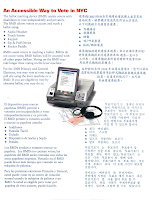
A mailing (to the left) from the New York City Board of Elections earlier this week notified voters that ballot marking devices (BMDs) will be available to voters who need assistance in every precinct. This long overdue development was mandated by the Help America Vote Act (HAVA) of 2002.
Six years and one lawsuit by the U.S. Department of Justice later, New York remains the least complaint in the nation with HAVA. Just when will the mechanical lever machines be replaced? According to Bo Lipari, the 2009 deadline is now slipping. New voting machines apparently are failing rigorous testing, which our colleague Larry Norden agrees with Bo is a good thing. Still, the state is required (once again) by law to install new machines in 2009.
Last week the Second Circuit Court of Appeals overturned the New York State Board of Elections' rule barring the use of absentee ballots in party county committee races. Under the law, absentee ballots were permissible in all other races, and were not allowed in party county committee races because they allegedly take too long to count. The decision calls the Board's rationale "flimsy," especially in light of the fact that local boards of election have up to nine days to complete their canvass and certify results. The court deemed the Board's argument so "exceptionally and extraordinarily weak" that it could not justify even an admittedly minor burden on First Amendment rights.
A small victory, perhaps, but it's nice to see folks take notice of the Board of Elections' often baffling logic.
By now we've all heard about the $427 million in budget cuts the legislature passed last week, but you may have missed this article in the New York Daily News about the word on the street that member items won't take much of a hit.
While the approved cuts include a $50 million reduction in member items, Assembly Speaker Sheldon Silver was quoted as telling his members that they wouldn't have to break any promises of cash for their constituents. We thought it might be an appropriate moment, then, to review a few highlights from the 2008-09 member items, culled from NY PIRG's member item database:
$750,000 in the Assembly for "activities including fashion industry modernization" in the garment district of Manhattan
$7,500 in the Assembly to improve the parking lot of the Catskills Elks Lodge
$50,000 in the Senate for a larger deck and boathouse for a YMCA summer camp in Warren County
$100,000 in the Senate for the Long Island Contractors Association's public outreach efforts
The list goes on (and on; there are about 5000 member items in each house for the 2008-09 fiscal year). And as we've blogged before, member items are wildly skewed toward the majority in both houses. If member items do take a cut under the new budget plan, we'll be anxious to see who wins out in the budgetary battle between the contractors and the little league.
Our colleague Andrew Stengel has an op-ed in the Albany Times Union this morning decrying the ethics crisis in the legislature exemplified by Bruno's quick transition from Senate majority leader to lobbyist this summer. Andrew and Susan Lerner of Common Cause argue that the state's Legislative Ethics Commission has neither the will nor the muscle to bring real reform to Albany.
I've been meaning to write about this for some time, but got a little side tracked in our national election-related work. A few weeks ago, a lot of ink was devoted to Governor Paterson's 34 vetoes. Not surprisingly (and quite properly) most of that attention was focused on the price tag of the various bills he vetoed.
I had a particular interest in one of those 34 bills that didn't have much of a price tag -- Senate Bill 5162. That bill would have required that county boards of election submit ballots to the State Board of Elections for review and approval whenever any state-wide candidate, proposed amendment to the constitution or other question provided by law to be submitted to a statewide vote is printed on a ballot.
Why was I interested in this bill? Because I recently co-authored a ballot design report that found New York has among the worst ballot design laws in the country -- in particular, the requirements for a full-face paper ballot, the requirement to include a party name and emblem next to every candidate name, requirements to use all capital letters instead of more readable mixed-case letters, and the unusually complicated, jargon-filled instructions provide a text-book example of a state election code that makes designing usable ballots particularly difficult.
New York hasn't had the high-profile ballot design debacles that other states, like California, Florida, Wisconsin and Ohio, have recently had (see the report if you want to look at how dramatically these debacles have affected high profile elections -- there are an astounding number of examples from just the past decade). But if things don't change, New York will eventually have the bad luck of so many other states. All it takes is a close race. And, as we noted in the report, "as New York makes its transition from lever machines to optical scan systems [next year], the problems caused by [these bad laws] are likely to become more apparent."
The reason I was so interested in Senate Bill 5162 was that it seemed to institute one of our recommendations: namely that State Boards review county-designed ballots (imagine how different history might have been if someone in the Florida Secretary of State's office had reviewed the Palm Beach butterfly ballot and told them that confusing design was unacceptable). Unfortunately, the bill seemed to have some major flaws: it didn't impose a deadline on the State Board for approving or rejecting ballots, and it didn't say what would happen if the bipartisan board became deadlocked and failed to act on a particular ballot.
We were encouraged by the Governor's veto message. He recognized the problems with the bill and made this point:
Poor ballot design remains an issue that often leads to disenfranchisement of voters. The inconsistent placement of candidate names on the ballot face may cause voter confusion and increased error rates. According to a July 2008 report entitled "Better Ballots," by the Brennan Center for Justice, poor ballot design frustrates voters, undermines confidence in the electoral process, and contributes to related Election Day problems. In fact, one state-level recommendation in the report is to have a state election official review local county ballot designs... I encourage the sponsors to work with my office to craft legislation that will help prevent voter confusion in a manner that considers the practical effects on election administration.
We hope the legislature will take him up on this offer. New York's election code makes designing a usable ballot far too difficult. That will have major consequences on our elections as we move from lever machines to paper ballots.
Joseph Bruno’s resignation continues to have an impact on the New York Senate -- Senate Republicans now have only 31 votes, putting the majority caucus below the 32 votes previously required to pass legislation. In Bruno’s absence, are fewer votes needed to pass a bill by majority vote?
The New York State Constitution implies that the passage of a bill requires a majority of the number of members elected to each chamber:
…nor shall any bill be passed or become a law, except by the assent of a majority of the members elected to each branch of the legislature.
The National Council of State Legislatures recently took noteof this potential problem. Few states are much clearer on the matter, but the Louisiana Supreme Court addressed the issue in 2005 when two state senators filed a petition against the President and Parliamentarian of the Louisiana Senate who had asserted that fewer votes were required for passage in light of two vacancies in the state senate. The Louisiana court’s decision may not bode well for New York Republicans:
“Members elected” and “elected members” in constitutional provisions requiring majority or super-majority of members of senate to pass bills or constitute quorum mean the entire membership authorized to be elected to each house, i.e., 39, not the elected, seated, and sworn members on the legislative day on which a vote is taken; thus, senate vacancies have no effect on counting of votes.
If votes are counted the same way in New York, things could really get interesting. We’ve blogged before about the impact of a more narrowly divided Senate under Skelos’ leadership – turns out that Republican fears about losing the majority may come to fruition well before Election Day.
Bo Lipari notes that New York's new voting machines keep failing during certification testing, and that this is a good thing. Here's why he thinks so. We agree that rigorous testing is a good thing -- and that it's better to find out about problems now then on Election Day.
Let's just hope the vendors get their acts together in time for New York to use its new voting machines by 2009, as it is required to do by law.
Generally speaking I'm a fan of increased oversight, especially in the case of member items.
This spring Attorney General Cuomo proclaimed that he would question the nearly $170 million of grants that come from state funds, in part to ensure that are no conflicts of interests between the recipient groups and the legislators.
As reported by Newsday's Michael Gormley, the first batch of rejected grants are posted to the attorney general's Project Sunlight. The nixed member items include $5,000 for a walk-in fridge for an Elks Lodge in Massapequa submitted by Long Island state Senator Charles Fuschillo due to "insufficient information." Other items were rejected due to constitutional or statuary concerns, or for lack of explanation of conflict of interest.
We don't often find ourselves on the same side of the aisle as the folks over at the Manhattan Institute, but the institute's new transparency website, SeeThroughNY, is illuminating to say the least. The site allows users to look through information on state government spending -- and it isn't pretty. A quick comparison of two rank-and-file members of the Senate who were elected in the same year shows that the majority member spent more than double the amount spent by the minority member on operations, personnel, mail, and travel.
The site has been so busy in its first 24 hours that it's still moving a little slowly - a story on WNYC this morning suggests that the bulk of the traffic is from state employees checking out their peers' salaries. Bad news, perhaps, for morale amongst minority staffers.
The New York State Board of Elections has fallen even further behind in its already-belated attempts to comply with the Help America Vote Act (HAVA).
This excerpt from the Board’s June 25th status report to the judge overseeing the court-ordered testing and implementation of new voting machines says it all:
“In the July 24th weekly status meeting SysTest announced that the vendors were not ready for testing at this point in time due to various issues, among them: documentation issues, testing machines supplied which did not function, lacked harddrives and or USB ports and therefore could not be tested. As of July 24, 2008 the timeline allowed only 16 days for the run [of] the record test by SysTest and when the Sequoia software was loaded up for a test pass, it crashed.”
Due to these challenges, SysTest, the independent contractor hired to test the machines, has reevaluated its testing timeline and now projects that it will not meet the October 1st, 2008 deadline for testing completion.
Who’s to blame here? We’re sure there is blame to go around, but missing hard drives and USB ports seem like pretty big oversights on the part of the manufacturers of the machines, ES&S and Sequoia. Here’s to hoping that the remainder of the testing process doesn’t get rushed along – We’ll have enough to worry about on election day without a bunch of voting machines that can’t be turned on.
Politico has a piece today exploring the wide world of congressional office expenditures, from a few hundred dollars spent on a specialty cleaning service, to a few thousand for flat screen TVs, to over a hundred thousand spent on constituent mailings.
This arguably unnecessary spending may make your blood boil, but we would note this paragraph:
For 2008, the House Administration Committee allocated each lawmaker a standard budget of $874,951. But members get an additional amount that’s tied to the distance between Washington and the farthest point in their districts — as measured on a Rand McNally map — and the relative cost of real estate back home.
Makes sense, right? All members get the same base allocation, plus travel expenses based on distance, plus an allocation for rent based on costs in the member's home district.
Contrast that with New York's legislator allocations based on partisan affiliation and loyalty to party leadership. The result of New York's inequitable system is very simple: if you and your neighbors choose to elect a maverick or a member of the minority party, your representative will have less staff and resources to look out for your interests and provide constituent services to your district.
New Yorkers should demand basic fairness in allocation of legislative resources, which, after all, come out of the taxpayer pool we all contribute to.
The Brennan Center for Justice at NYU School of Law is a nonpartisan law and policy institute that seeks to improve our systems of democracy and justice.

 Micah Kellner, Assemblyman of the 65th district of Manhattan's Upper East Side, released his ethics disclosure form for us to post and for all to see. It's available as a PDF file download here. For the unfamiliar it's worth reading for the range of questions.